Net Ecosystem Productivity (NEP) represents the net carbon exchange between terrestrial ecosystems and the atmosphere. Without considering natural or anthropogenic disturbances, NEP quantitatively describes the carbon source/sink capacity of terrestrial ecosystems. Positive NEP indicates a carbon sink, while negative values indicate a carbon source. The Global Terrestrial NEP Product includes monthly and annual NEP data for global terrestrial ecosystems from 1981 to 2020. The monthly product contains 12 datasets per year, and the annual product aggregates data from all 12 months. Due to algorithmic differences, the product has two spatial resolutions: 5km (1981-2018) and 500m (2000-2020). All data are in NetCDF format with geographic coordinates.
Global NEP estimation used a random forest model and NEE (NEE = -NEP) observations from FLUXNET (https://fluxnet.fluxdata.org/). Predictor variables included global spatial datasets such as MODIS (leaf area index, evapotranspiration, land surface temperature, surface reflectance, gross primary productivity, land cover), GLASS (leaf area index, fraction of absorbed photosynthetically active radiation, evapotranspiration, land surface temperature), ERA5 (air temperature, total precipitation), SPEI drought index, soil respiration, forest height, soil organic carbon, and DEM. Variable importance and collinearity analysis identified 11 optimal predictors for 5km monthly NEE and 13 for 500m monthly NEE. For 5km NEE (1981-2018), predictors included GLASS AVHRR LAI and evapotranspiration (5km), ERA5 air temperature and precipitation (0.25°), MODIS land cover (500m), and soil respiration (1km). For 500m NEE (2000-2020), predictors included MODIS LAI, evapotranspiration, surface reflectance, and land cover (500m), ERA5 precipitation (0.25°), and soil respiration (1km).
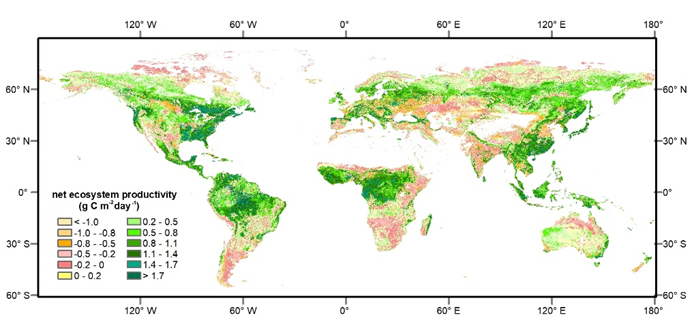
Spatial Distribution Map of Global 5km Net Ecosystem Productivity (August 1995)
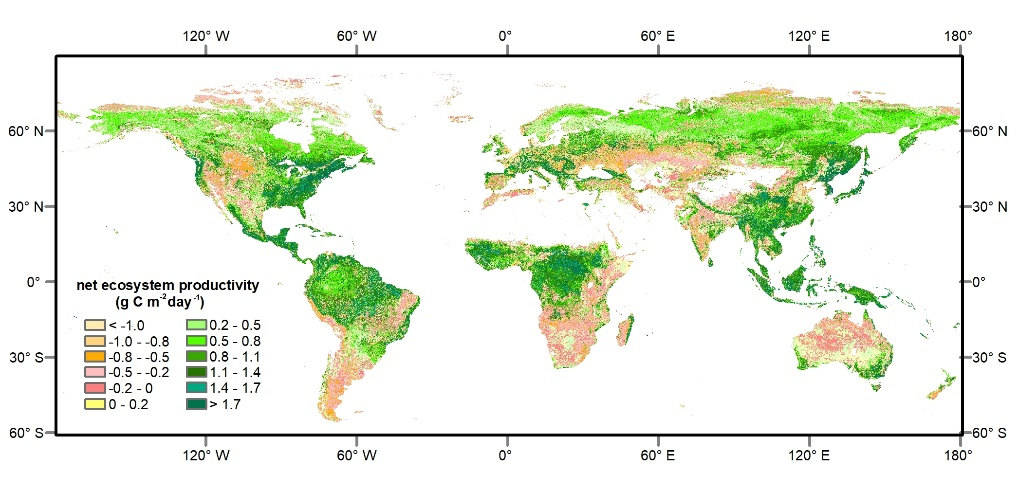
Spatial Distribution Map of Global 500m Net Ecosystem Productivity (August 2015)
Core Functions
This product provides data support for global change and carbon cycle research.
References
Huang, N., Wang, L., Zhang, Y.L., Gao, S., Niu, Z. (2021) Estimating the net ecosystem exchange at global FLUXNET sites using a random forest model. Journal of Selected Topics in Applied Earth Observations and Remote Sensing, DOI: 10.1109/JSTARS.2021.3114190.
https://www.geodata.cn/main/face_scientist?categoryId=&word=%E5%85%A8%E7%90%83%E9%99%86%E5%9C%B0%E5%87%80%E7%94%9F%E6%80%81%E7%B3%BB%E7%BB%9F%E7%94%9F%E4%BA%A7%E5%8A%9B
Product Owner Introduction
Huang Ni, Associate Professor and Master's Supervisor at the Aerospace Information Research Institute, Chinese Academy of Sciences. Her research focuses on remote sensing inversion of carbon cycle parameters in terrestrial ecosystems. She has led projects supported by the National Natural Science Foundation of China and the National Key R&D Program.
Contact Information
Huang Ni (huangni@aircas.ac.cn)