Researchers from the Aerospace Information Research Institute (AIR) of the Chinese Academy of Sciences have developed an improved change detection method, based on the time series data from Sentinel-1 radar and Sentinel-2 optical sensors (2019–2021) to estimate surface soil moisture. This method sheds light on the intricate dynamics of the hydrological cycle and ecological environment in permafrost regions. The study was published in GIScience & Remote Sensing, and the corresponding dataset was published on the website of the National Tibetan Plateau Data Center.
The response of backscatter to soil moisture in bare soil was expressed in a logarithmic form. To account for the impact of vegetation on backscatter, the influence function of the normalized difference vegetation index (NDVI) was established for vegetation-covered surfaces. This effectively mitigated the influence of vegetation, allowing for accurate determination of the change in backscatter relative to bare soil conditions.
Besides, the researchers formulated an empirical function to ascertain reference (minimum and maximum) values of soil moisture in each pixel, facilitating accurate retrieval of soil moisture. The study focused on the Wudaoliang permafrost region of the Qinghai-Tibet Plateau, and the results were validated against ground measurements.
The retrieval results of the improved change detection method exhibit correlation coefficients ranging from 0.672 to 0.941 with root mean squared errors (RMSE) ranging from 0.031 m3/m3 to 0.073 m3/m3. This method demonstrated higher correlation and lower RMSE compared to the Soil Moisture Active Passive (SMAP) 9-km product.
Furthermore, the soil moisture retrieved from Sentinel exhibited a strong correlation with the SMAP 9-km soil moisture over time, providing a more accurate representation of the region's soil moisture heterogeneity. This method showcases the feasibility of combining Sentinel-1 and Sentinel-2 for high-resolution (100 m) soil moisture mapping in permafrost regions.
For further information, please contact ZHAO Tianjie at zhaotj@aircas.ac.cn
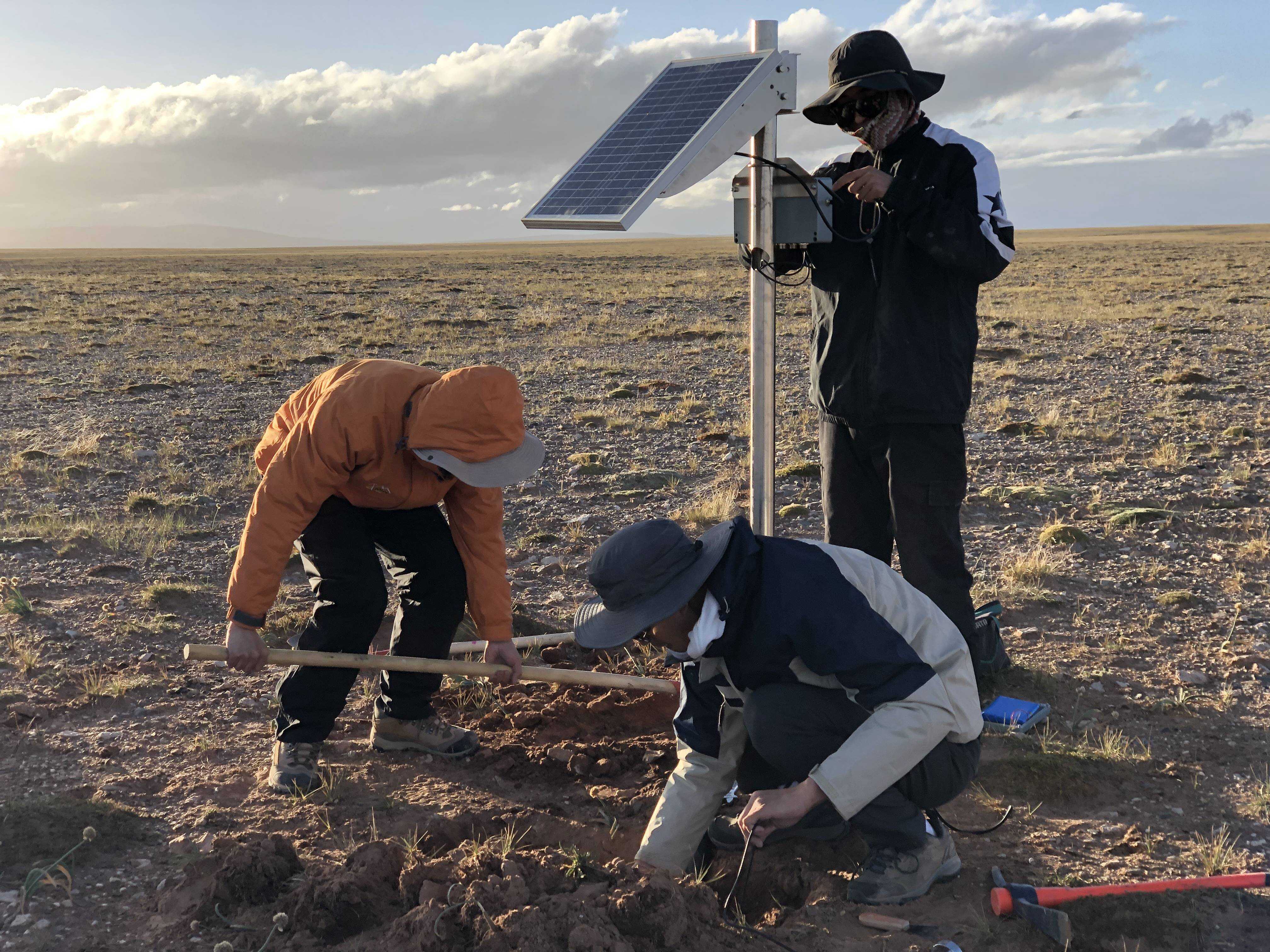
Researchers and students set up ground observation instruments and collect soil samples in permafrost regions over Qinghai-Tibet Plateau