In a study published in Earth System Science Data, a research team led by SHI Yusheng from the Aerospace Information Research Institute of the Chinese Academy of Sciences, utilizing data from the China's Fengyun-3D satellite, unveiled a comprehensive global inventory of emissions from open biomass burning (OBB), providing crucial insights into the impact of OBB on air quality, climate, and human health.
The Fengyun satellite can detect small fires, coupled with biomass data and combustion efficiency indices derived from vegetation indices. The data from the satellite allows for a more accurate estimation of OBB emissions compared to previous methods that relied heavily on MODIS active fire products.
OBB refers to the act of burning plant material in open spaces. In this study, researchers focused on the role that OBB plays in releasing various pollutants, including carbon dioxide (CO2), carbon monoxide (CO), methane (CH4), and particulate matter (PM2.5 and PM10).
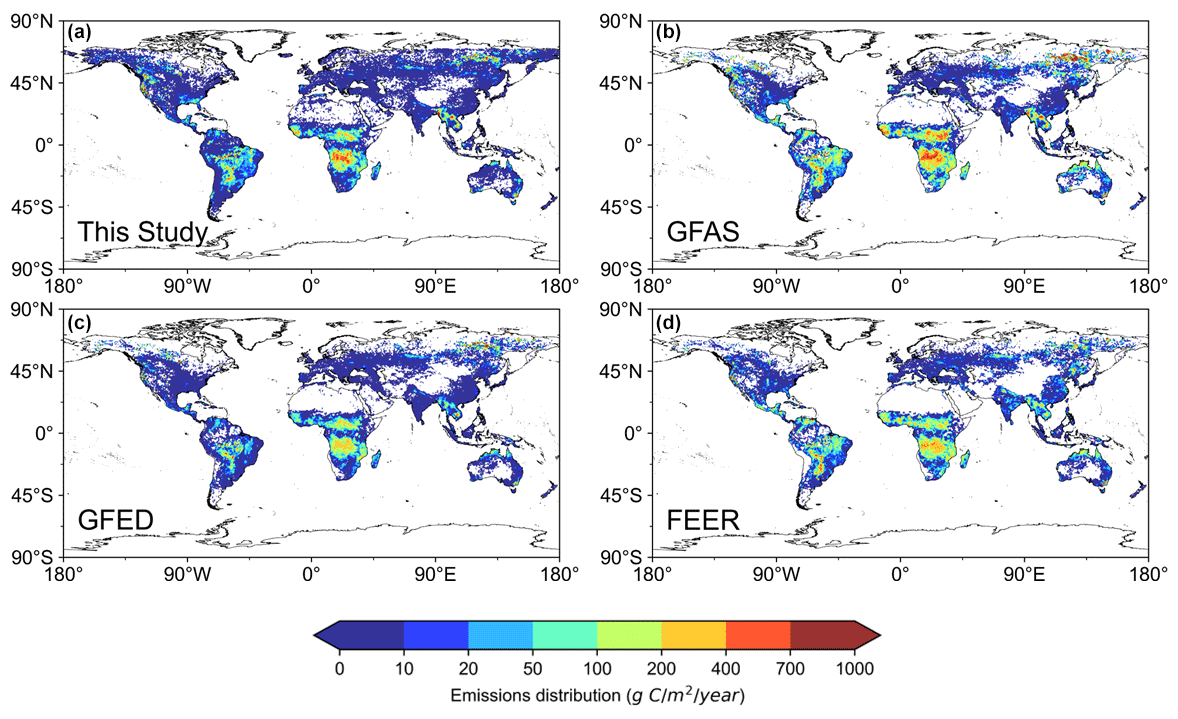
By leveraging high-resolution daily fire spot monitoring data from the Fengyun-3D satellite, researchers developed a global OBB emission inventory with a resolution of 1 × 1 km for the year from 2020 to 2022. They found that, on average, OBB produces a large amount of pollution each year. Specifically, it releases 2,586.88 teragrams (Tg) of C, 8,841.45 Tg of CO2, 382.96 Tg of CO, and 15.83 Tg of CH4.
Southern Hemisphere Africa was identified as the largest source of carbon from OBB, contributing 847.04 Tg of carbon each year. Other major contributors included Southern Hemisphere South America with 525.56 Tg of carbon per year and Northern Hemisphere Africa with 394.26 Tg of carbon per year.
Savanna grasslands were found to be the predominant source of carbon emissions, accounting for 46.74% of the total annual emissions. This was followed by woody savannas/shrubs and tropical forests, which contributed 33.04% and 12.11%, respectively.
Besides, notable seasonal variations in carbon emissions were observed, with peaks in September 2020, and August of 2021 and 2022. The average emissions during these peak months were significantly higher than the monthly average.
These findings of this study are crucial for improving air quality models and understanding the biogeochemical cycles affected by OBB. The detailed emissions data is expected to aid in devising strategies to mitigate the adverse effects of biomass burning on the environment and public health.
The Global Emissions Inventory from Open Biomass Burning (GEIOBB) dataset is publicly available for further research and analysis.